
Persian Modes: Reading Between the Lines of Western
Music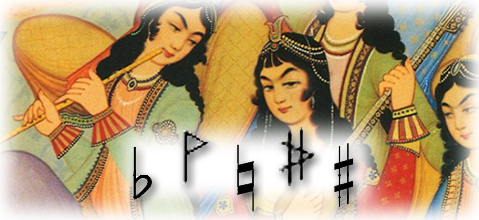
Practical correspondence of microtonal Persian modes to
western modes

by Salim Ghazi Saeedi, Jun 2012
Persian modes (Mayeh in
Persian music[1]) contain quarter tones that are not
used in western modes. Persian music uses two accidentals for demonstrating
these quarter tones: Koron
 (one quarter tone lower) and Sori
  (one quarter tone higher).
Persian Intervals
Speaking of intervals, I use the terms "half" and "over" as prefixes for correspondingly decreasing and increasing an interval one quarter tone. I have borrowed the English names from nim and bish as used in Pourtorab et al[2] (See Table 1).
Table 1: Persian intervals vs. western intervals

Persian Tetrachords
Like western music, the modal system in Persian music is also built upon tetrachords (Dāng). But there is an important difference. In order to build up scales in western music, tetrachords juxtapose by having one whole tone interval in between. In Persian music scales, tetrachords juxtapose immediately beside each other. for example:
in western music, two Dorian tetrachords (tone-halftone-tone) build up this scale having C as the key: C-D-Eb-F-G-A-Bb-C
while
in Persian music, two tanini-baghiye-tanini tetrachords (which is similar to western Dorian tetrachord) build up this scale with having C as the key: C-D-Eb-F-G-Ab-Bb-C (Octave C does not belong to none of tetrachords. It is added for sake of tonic note).
So in Persian music two tetrachords do not automatically repeat the tonic note (in 1st degree) in 8th degree.
Persian Modes
At the following the intervals for all Persian modes are provided. As you see in diagrams, in each Persian mode by moving one quarter tone high or low for certain degrees we arrive at western modes[3].
It should be noted that the presence of quarter tones in Persian modal system is only in form of 3/4 tone intervals. A single 1/4 (actual quarter tone) is used nowhere within one mode.
At the following charts, solid lines denote western tempered intervals and dashed lines denote Persian intervals. The ø symbol represents the term "half" mentioned above. e.g. øM2 = 3/4 tone interval = one quarter tone lower than Major 2nd interval or 4ø+ = 11/4 tone interval = one quarter tone lower that 4+
Modulation between Persian and western modes
I think the importance of these diagrams is if you are familiar with western modal systems and are skillful in performing them on the instrument, you can easily modulate to a neighbor Persian mode. And more excitingly you can even re-modulate to another related western mode from there. As an example consider you are playing E Phrygian. Now you can modulate to E Nava by making II degree one quarter tone higher. From there you can re-modulate to E Natural Minor by making II degree in quarter tone higher.
Also notice that by changing the tonic degree, you can find numerous other Persian modes that however that have no associated name in Persian modal system, but they relate to other Western modes. e.g. while you don't see Dorian in the following charts related to any Persian modes, you can use the chart for Abu-Ata if you associate the tonic to degree VII . So you can use G Abu-Ata with its tonic on A (Shāhed on A) as a mode closely related to A Dorian - with only quarter note difference in A Dorian's third degree.
It should be noted that using non-equal temperament systems are also prevalent in Persian music that is not subject of this article.
Shur (Shūr) comes between Phrygian b5 & Natural Minor

Abu-Ata (Abu-Atā) comes between Phrygian & Natural Minor

Bayat-e-Turk (Bayāt-e-Turk) comes between Natural Minor & Mixolydian

Dashti-variation#1‡ comes between Phrygian & Natural Minor

Dashti-variation#2‡ comes between Phrygian b5 & Natural Minor

Nava (Navā) comes between Phrygian & Natural Minor

Segah (Segāh) comes between Phrygian b5 & Mixolydian

Chahargah (Chahārgāh) comes between Mixolydian b2 b9 & Mixolydian

Homayun (Homāyun) comes between Dorian b2 b5 & Dorian

Bayat-e-Esfahan (Bayāt-e-Esfahān) comes between Phrygian Major & Mixolydian b6

Mahur (Mahūr) and Mixolydian are the same†

The following two modes span above one octave. They contain 3 tetrachordes.
Rast Panjgah (Rāst Panjgāh) and Mixolydian b6b9 are the same†

Afshari (Afshāri) comes between Natural Minor b5 b9 & Mixolydian b9

Notes
†
In an equal temperament system
of tuning.
‡
Dashti is associated to two different interval sets.
References
[1] Talai, Dariush, A New Approach to the Theory of Persian Art Music: the Radif and the Modal System, Mahur, 1993, Iran, Tehran
[2] Pourtorab, M.K. et al, Theoretical fundamentals of Persian Music, Mahur, 1388 (2009-2010), Iran, Tehran
[3] Persian modes are based on Pourtorab, M.K. et al, Theoretical fundamentals of Persian Music, Mahur, 1388 (2009-2010), Iran, Tehran, page 77.
Right Notices
Text:
(C) Jun 2011, Salim Ghazi Saeedi
Images:

Persian Mode vs. Western Mode Diagrams by
Salim Ghazi Saeedi
are licensed under a
Creative Commons Attribution 3.0 Unported License.
Based on a work
at
www.salimworld.com.